
HTMX & WebStencils : Fast Web Development with RAD Studio
13/11/2024
Antonio Zapater
This book focuses on a modern, streamlined approach to web development using HTMX and WebStencils.
HTMX is a lightweight JavaScript alternative for building dynamic web user interfaces and is becoming the goto solution for web developers as it helps them significantly reduce the amount of JavaScript they need to write, making the development process faster and more intuitive, simpler to read and debug and easier to maintain.
HTMX’s simplicity aligns perfectly with RAD Studio’s rapid application development ethos, allowing developers to focus more on application logic instead of struggling with complex front-end code.
The beauty of WebStencils lies in its template-driven architecture. Instead of reinventing the wheel, developers can expose existing business logic via reusable and customisable templates that seamlessly integrate with existing applications, reducing the friction of bringing older projects to the web. This not only accelerates development but also enhances collaboration between development teams, enabling them to work more closely with existing codebases.
By reading this book, you will learn how to leverage the power of HTMX and WebStencils to develop modern web applications with less effort and greater flexibility. Whether you are working on enhancing existing desktop applications for the web or building new, dynamic web projects, this book provides practical insights to help you get the most out of RAD Studio’s evolving web development ecosystem.
You can learn more about RAD Studio or download a free trial to code along with the examples in this book from https://www.embarcadero.com/products/rad-studio
Let’s dive into how these technologies can simplify your workflow and take your web development projects to the next level!
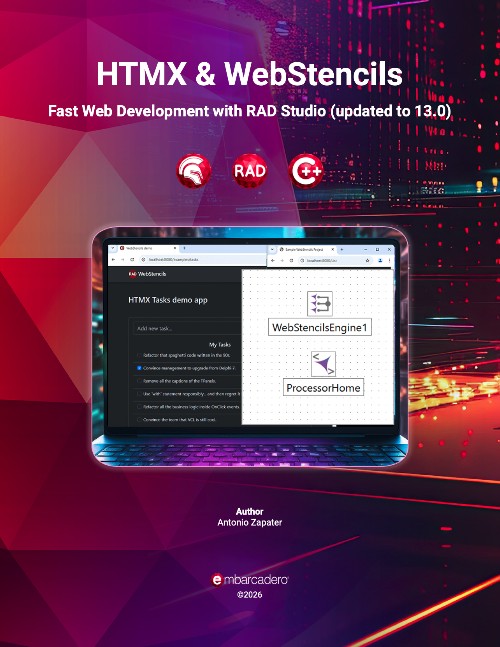
HTMX & WebStencils v2.0 : Fast Web Development with RAD Studio (updated to 13.0)
18/02/2026
Antonio Zapater
RAD Studio introduced WebStencils, a server-side script-based integration and processing of HTML files.
This ebook focuses on a modern, streamlined approach to web development using HTMX and WebStencils.
HTMX’s simplicity aligns perfectly with RAD Studio’s rapid application development ethos, allowing developers to focus more on application logic instead of struggling with complex front-end code.
The beauty of WebStencils lies in its template-driven architecture. Instead of reinventing the wheel, developers can expose existing business logic via reusable and customisable templates that seamlessly integrate with existing applications, reducing the friction of bringing older projects to the web. This not only accelerates development but also enhances collaboration between development teams, enabling them to work more closely with existing codebases.
Written by Antonio Zapater, this guide will show you how to harness the power of HTMX and WebStencils to develop modern Web applications with less effort and greater flexibility.
What’s New in this v2 ?
This isn’t just a few tweaks here and there. We’ve reworked existing chapters to cover new features introduced since RAD Studio 12.2, and added several entirely new chapters such as:
- Session Management and Authentication – Practical patterns for handling user sessions and login flows
- Database-Driven UI Generation – Techniques for building dynamic interfaces from database metadata
- Working with Modern CSS Frameworks – Integration strategies for Tailwind CSS and other modern styling tools
- Deployment Options and Docker – Real-world deployment scenarios and containerization approaches

RAD Server Technical Guide (version 2)
15/09/2023
Antonio Zapater, David I.
RESTful architectures are a key driving force behind modern API first application design. This book focuses on the RAD Server framework included with RAD Studio (Delphi/C++Builder) for developing such platforms.
RAD Server is a full backend MEAP (Mobile Enterprise Application Platform) that enables Desktop, Mobile and Web frontend development in any language, and this book is designed as a definitive guide for developers.
The benefit of a MEAP is that you have a pre-built cloud or on-prem server with many core capabilities (such as push notifications, user tracking and analytics) that you can plug into rapidly to deliver remote database and functional access.
This guide to Embarcadero RAD Server, originally authored by David I (2019), is in its second edition, revised by Antonio Zapater (2023), which includes many additional features added based on market demand since RAD Servers Launch. The second edition is also supported by a comprehensive video series supporting each chapter, along with source code examples on GitHub.

RAD Server Technical Guide (version 3)
02/02/2026
Antonio Zapater, David I.
RESTful architectures are a key driving force behind modern API first application design. This book focuses on the RAD Server framework included with RAD Studio (Delphi/C++Builder) for developing such platforms.
RAD Server is a full backend MEAP (Mobile Enterprise Application Platform) that enables Desktop, Mobile and Web frontend development in any language, and this book is designed as a definitive guide for developers.
The benefit of a MEAP is that you have a pre-built cloud or on-prem server with many core capabilities (such as push notifications, user tracking and analytics) that you can plug into rapidly to deliver remote database and functional access.
This guide to Embarcadero RAD Server, originally authored by David I (2019), is in its third edition, revised by Antonio Zapater (2024, 2025), which includes many additional features added based on market demand since RAD Servers Launch. This edition is also supported by a comprehensive video series supporting each chapter, along with source code examples on GitHub.
What’s New in this 3rd edition ?
The new release adds eight more chapters covering advanced features and real-world scenarios:
- Chapter 11: Authentication and Authorization
- Chapter 12: Documenting and testing your endpoints using OpenAPI (Swagger)
- Chapter 13: File management and storage
- Chapter 14: EdgeModules: Extending RAD Server
- Chapter 15: RAD Server and WebStencils
- Chapter 16: RAD Server Multi-Tenancy Support
- Chapter 17: Mapping Endpoints to External Classes
- Chapter 18: Extending RAD Server with Resource Interceptors
Combined with the original ten chapters, you now have complete coverage of RAD Server from basic setup through advanced customization and deployment.
As always, the guide includes downloadable source code examples and video tutorials for each chapter, making it easy to follow along and implement these features in your own projects.